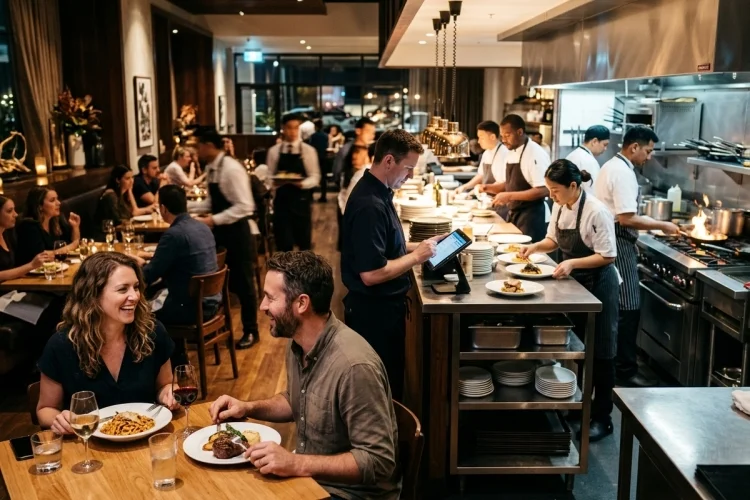
A faster restaurant is not necessarily a better restaurant. Guests want their drinks, food, and checks delivered without unnecessary waiting, but few people enjoy feeling like the staff is trying to reclaim the table before dessert arrives.
Understanding How Restaurant Operators Improve Throughput means finding the delays guests dislike while protecting the moments they actually enjoy.
The smartest operators improve table utilization by redesigning service flow, removing bottlenecks, forecasting demand, and speeding up invisible processes rather than simply telling servers to push customers through the meal faster.
Separate Waiting Time From Enjoyable Dining Time
Meal duration is not automatically the enemy.
Guests may happily spend twenty minutes talking over drinks but become frustrated by an eight-minute wait for someone to take their order. Those minutes feel completely different.
Cornell research on restaurant revenue management found that customers tend to prefer some service stages to move quickly, particularly order taking, check delivery, and payment, while they are less comfortable being hurried through the actual meal.
That distinction gives operators a better strategy.
Instead of targeting total dining time blindly, map the guest journey into individual stages:
Seating → Greeting → Drinks → Ordering → Food Delivery → Clearing → Check → Payment
Measure each stage and identify unnecessary gaps.
If the average table spends twelve minutes waiting between requesting the bill and completing payment, removing eight minutes there improves throughput without touching the enjoyable part of the experience.
This is service effeciency rather than guest rushing.
Measure Table Turns With Context
Table turnover shows how many parties a restaurant serves from each table during a particular service period.
If 30 parties use 10 tables during dinner, the restaurant averages three turns per table.
Toast identifies table turnover as an important restaurant sales metric because additional parties served from existing tables can increase revenue without expanding physical capacity.
But the number needs context.
A fine-dining restaurant may naturally have longer dining times than a neighborhood café. Party size, menu complexity, daypart, and average check also influence what a healthy turn time looks like.
Lightspeed defines turn time as the period from opening a guest check through payment and uses it to help operators understand how quickly tables move through service.
Managers should therefore compare similar services rather than chasing a universal target.
Tuesday lunch should be compared with other lunches. Saturday dinner should be compared with similar peak periods.
The aim is improving your own baseline without damaging hospitality.
Remove Front-of-House Bottlenecks First
Many restaurants lose capacity before the kitchen even becomes involved.
A table may sit empty because nobody has cleared it. Guests may wait at the host stand while clean tables remain unassigned. Servers may delay entering orders because the POS station is occupied.
These small gaps accumulate.
Imagine a 100-seat restaurant serving 180 dinner covers. If better bussing and seating coordination allows just one additional 20-person wave during peak demand, the restaurant increases throughput without shortening anyone’s meal.
Technology can help here.
Lightspeed and OpenTable have highlighted how real-time table-status information can improve table turnaround by allowing hosts to see when tables become available rather than relying on manual communication.
The same principle works without expensive systems.
Clear table ownership, defined clearing standards, mobile POS devices, and better communication between hosts and servers can remove dead time.
The fastest improvements often happen between guests rather than during their meals.
Fix Kitchen Pacing Instead of Simply Cooking Faster
Front-of-house speed means little when the kitchen cannot handle incoming demand.
The goal should be predictable production flow, not asking cooks to move frantically.
Suppose a kitchen can comfortably produce 60 entrées every 30 minutes. Seating 45 guests at once and another 45 five minutes later may create a sudden ticket pile that overwhelms the line.
A more controlled seating rhythm spreads demand.
Reservations can be staggered, walk-ins can be paced, and hosts can coordinate with kitchen capacity before seating another large group.
Cornell’s restaurant revenue-management work recommends forecasting arrival patterns and redesigning internal service processes as ways to manage dining duration without directly restricting how long customers stay.
Menu design matters too.
If seven popular dishes depend on one grill station, that station becomes the constraint. Moving one preparation to another piece of equipment or simplifying a garnish can improve througput across the entire restaurant.
Small kitchen redesigns can save more time than telling every employee to “work faster.”
Schedule Labor Around Service Peaks
Throughput problems often look like staffing problems, but the real issue may be when employees are scheduled.
Restaurant traffic rarely arrives evenly.
A restaurant might serve 20% of dinner customers between 5 p.m. and 6 p.m., then receive nearly half of its volume between 7 p.m. and 8:30 p.m.
Staffing should follow that demand curve.
Sales per labor hour, or SPLH, can help managers evaluate how much revenue is generated for every paid labor hour. 7shifts defines SPLH as total sales divided by total labor hours and recommends comparing the metric by shift rather than relying only on weekly averages.
However, the highest possible SPLH is not necessarily desirable.
Extreme productivity numbers may mean the restaurant is understaffed. Servers become overloaded, bussing slows, drinks take longer, and guests wait unnecessarily.
Good labor forcasting finds the point where employees remain productive without becoming overwhelmed.
Cross-training can also help. A host capable of supporting table resets during sudden peaks or a food runner trained to assist another station gives managers more flexibility without maintaining excess staffing throughout the entire shift.
Make Payment Almost Frictionless
The end of the meal is one of the easiest places to recover time.
Guests who are ready to leave rarely consider waiting for the bill a premium hospitality experience.
Traditional payment might involve requesting the check, waiting for the server, receiving the check, providing a card, waiting again, signing, and finally leaving.
Mobile payment can remove several of those stages.
The goal is not putting a payment device on the table while guests are still eating. It is making fast payment available the moment they are ready.
Restaurants can also train servers to recognize signals.
Guests putting coats on, checking transportation apps, moving belongings, or asking about parking may be preparing to leave. Anticipating that moment makes service feel attentive rather than rushed.
Lightspeed’s recent work around restaurant pacing similarly emphasizes measuring the rhythm of service so teams can eliminate delays while maintaining the experience guests expect.
That is an important distinction.
Excellent pacing feels invisible. Guests simply notice that everything happened when it should.
Track Revenue per Seat-Hour Alongside Guest Feedback
More covers are useful only when they generate sustainable value.
Restaurant revenue management often uses Revenue per Available Seat Hour, or RevPASH, to connect sales with both capacity and time. Cornell research positions the seat-hour as a useful unit because restaurant inventory is effectively time-sensitive.
Suppose a 100-seat restaurant generates $15,000 over five available seat-hours.
That equals:
$15,000 ÷ 500 seat-hours = $30 RevPASH
If better service flow raises revenue to $16,500 from the same capacity, RevPASH increases to $33.
But financial metrics should be paired with guest indicators.
Monitor reviews, complaints, repeat visits, satisfaction scores, and server feedback after changing service processes.
If table turns improve while complaints about rushed service rise, the restaurant has optimized the wrong thing.
Throughput and consistancy should improve together.
Knowing How Restaurant Operators Improve Throughput is really about removing unwanted waiting rather than shortening hospitality.
Better seating flow, kitchen pacing, labor planning, faster payment, and smarter capacity measurement can serve more guests while keeping meals relaxed.
Map your service journey this week, identify the three longest avoidable delays, and fix those before setting aggressive table-turn targets.