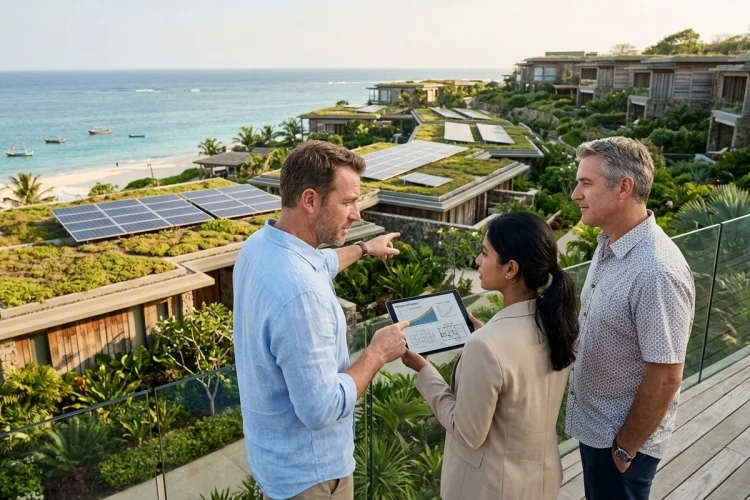
Sustainability in resorts is often discussed through solar panels, recycled materials, and green certifications. Those things matter, but the bigger financial picture is what happens during the next twenty or thirty years of operation.
Advanced Resort Sustainability connects environmental performance with lifecycle cost, asking not only what a design costs to build but also what it will cost to cool, maintain, replace, and operate.
For resort owners, that shift is important. A slightly higher upfront investment can make sense when it reduces energy use, water consumption, equipment replacement, and operational headaches for decades.
Look Beyond the Initial Construction Budget
The cheapest building solution on opening day is not always the cheapest asset over time.
Lifecycle cost analysis considers more than initial capital expenditure. It can include energy, water, maintenance, replacement cycles, operating costs, and the residual value of systems over a defined period.
NIST’s lifecycle costing framework is specifically designed to compare long-term building investments involving energy conservation, water conservation, renewable energy, resilience, and other high-performance building strategies.
That approach is highly relevant to resorts.
For example, a cheaper façade system may require frequent repainting or replacement in a coastal environment. A more durable specification might cost more initially but produce lower maintanance costs over twenty years.
The better question is therefore not, “Which option costs less today?” It is, “Which option creates the lowest total ownership cost?”
Treat Energy Efficiency as an Asset Strategy
Resorts can be energy-intensive because guestrooms, restaurants, pools, spas, laundries, kitchens, lighting, and air-conditioning systems operate for long periods.
Reducing that demand starts with architecture.
Orientation, shading, insulation, efficient glazing, natural ventilation, daylight, and properly sized mechanical systems can lower energy consumption before renewable technologies are added.
USGBC reports that green buildings, on average, use about 26% less energy and emit 33% less carbon dioxide than conventional buildings. Its hospitality guidance specifically highlights energy efficiency as a major opportunity for hotels and venues.
The U.S. Department of Energy has also documented substantial financial savings from energy-efficiency upgrades across commercial buildings, including hospitality properties.
For developers, those savings become increasingly meaningful across decades of operation.
Reduce the Load Before Adding Technology
Solar panels can be valuable, but reducing energy demand first often produces a stronger strategy.
A shaded room that needs less cooling requires less energy every day, whether its electricity comes from the grid or rooftop solar.
Make Water Part of the Financial Model
Water sustainability is especially important for resorts with extensive landscaping, pools, spas, laundry operations, and food-and-beverage outlets.
In water-stressed destinations, the financial and operational risks become even greater.
Efficient fixtures, smart irrigation, native planting, rainwater harvesting, wastewater reuse, and leak detection can reduce demand without noticeably reducing guest comfort.
USGBC says green buildings average roughly 30% lower indoor water use.
Meanwhile, IFC’s EDGE framework evaluates buildings against energy, water, and embodied-energy performance, with its certification approach built around meaningful efficiency improvements compared with local benchmarks.
For a resort, water savings can also reduce secondary costs.
Less hot water means less energy for heating. Efficient landscaping can lower irrigation and gardening requirements. Smaller demand may reduce pressure on treatment and pumping systems.
Sustainability measures often interact rather than operating separately.
Design for Durability in the Local Climate
Resort locations can be tough on buildings.
Salt air corrodes metal. Tropical humidity damages finishes. Intense sunlight fades surfaces. Sand, storms, snow, and temperature swings create additional stress.
Selecting materials purely for their appearance can therefore produce expensive long-term problems.
A lifecycle strategy evaluates how frequently finishes, equipment, furniture, and façade components will need replacement.
Local climate should shape those decisions from the beginning.
At JW Marriott Jeju, for example, WATG incorporated locally sourced lava rock and architectural responses connected to Jeju Island’s volcanic landscape and regional character.
Local sourcing alone does not guarantee sustainability, but materials suited to their context can contribute to durability, identity, and reduced transportation impacts.
The ideal resort material is not simply beautiful. It should age reasonably well.
Measure Maintenance Before Choosing Complex Design
A dramatic architectural feature can become very expensive when operators need scaffolding, specialist contractors, or imported replacement components every few years.
Lifecycle planning therefore needs input from facilities teams.
Can façade panels be replaced individually? Can maintenance staff reach lighting and mechanical equipment easily? Are filters, pumps, and valves accessible without disturbing guestrooms?
Cornell’s sustainability program emphasizes connecting sustainable building strategies with everyday operational efficiency, environmental practices, and long-term building management.
This is where environmental goals and practical economics meet.
A highly efficient system that is difficult to maintain may eventually operate poorly because staff cannot service it correctly.
Good sustainability should simplify operations where possible, not create constant technical frustration.
Use Certification as a Framework, Not the Final Goal
Certifications such as LEED and EDGE can provide valuable benchmarks.
LEED addresses areas including energy, water, materials, waste, transportation, and indoor environmental quality, while EDGE focuses strongly on measurable resource efficiency.
However, certification should support the asset strategy rather than replace it.
A resort can earn sustainability credentials while still making poor lifecycle decisions in areas outside the certification calculation.
Owners should therefore connect certification targets with operational KPIs such as energy per occupied room, water per guest night, maintenance cost per key, and equipment replacement frequency.
The most useful sustainability program continues after opening.
It becomes part of asset management.
Protect Natural Assets That Support Resort Value
A resort’s natural environment can be one of its most valuable commercial assets.
Healthy reefs, beaches, forests, wetlands, wildlife, and landscape character can influence why travelers choose the destination in the first place.
WATG’s work on The Red Sea development uses a phased master-planning strategy that integrates environmental, marine, infrastructure, architectural, mobility, and guest-experience considerations around long-term sustainability.
This is an important reminder that protecting ecology is not separate from resort economics.
Environmental degradation can weaken the very experience the resort sells.
Advanced planning therefore evaluates biodiversity and landscape preservation as part of long-term asset resiliance, not simply corporate responsibility.
Advanced Resort Sustainability becomes more powerful when environmental goals are connected directly with lifecycle economics.
Energy, water, durable materials, maintenance access, certification, and ecological protection all influence how expensive a resort will be to own over time.
Instead of comparing designs only by construction cost, developers should model decades of operation. Start measuring total ownership value early, while the most important design decisions are still flexible.