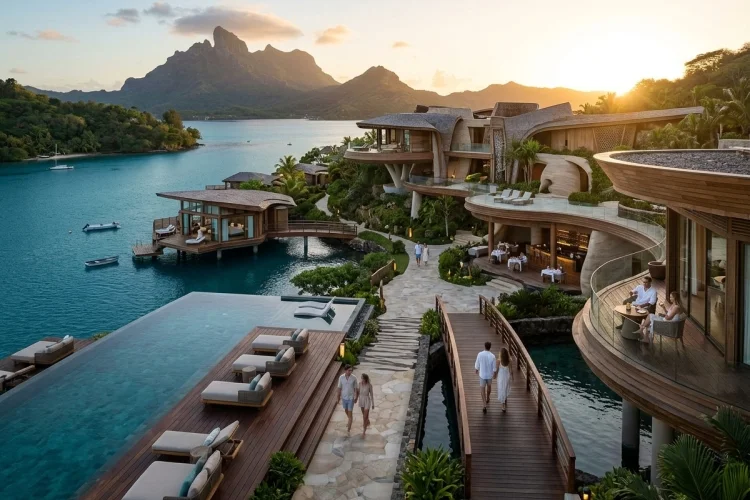
Two resorts can offer similar room sizes, pools, restaurants, and beachfront access, yet guests may happily pay far more for one of them. The difference often begins with architecture.
Guests judge value through what they see, feel, and experience long before they calculate square meters or compare amenity lists.
Understanding how resort architecture shapes perceived value helps explain why arrival sequences, views, privacy, materials, proportions, and even pathways can influence premium positioning.
Great architecture does not simply make a property attractive. It gives guests reasons to believe the experience deserves a higher price.
Architecture Becomes a Signal of Quality
Guests rarely know exactly how much a resort cost to build. Instead, they read visual signals.
A dramatic lobby, generous ceiling height, beautifully framed landscape, refined materials, and carefully detailed outdoor spaces can communicate quality before the guest interacts with staff. These elements create expectations about the standard of everything that follows.
Research examining lifestyle hotel design found that perceived uniqueness and perceived expensiveness were positively related to overall value perception, which was then associated with booking intention and willingness to pay.
That is commercially important. Architecture can act almost like packaging for the hospitality product.
When the built enviroment looks thoughtful and distinctive, guests may assume the service, food, wellness, and accommodation experience will meet the same standard.
The Arrival Sequence Sets the Price Expectation
The guest experience does not begin at the reception desk.
It may begin at a resort gate, coastal road, boat jetty, landscaped driveway, or shaded walkway. Every transition helps establish what kind of destination guests believe they have purchased.
WATG describes hospitality arrival as a carefully choreographed sequence involving architecture, landscape, interiors, and master planning. The objective is to establish expectations and emotional tone from the first moments of the stay.
Consider an ocean resort where guests enter through a relatively enclosed arrival pavilion before suddenly seeing a panoramic sea view.
The architecture creates contrast. That reveal feels more dramatic than simply exposing the ocean from the parking area.
Nothing about the coastline has changed, but its perceived value has.
Spaciousness Can Make Luxury Feel More Expensive
Luxury is frequently associated with space, but the relationship is more subtle than simply making everything bigger.
Guests notice breathing room around furniture, generous pathways, uncluttered terraces, tall ceilings, and clear seperation between active and quiet areas.
Hospitality servicescape research found that spaciousness was especially important in predicting favorable guest behaviors. The same study also found that pleasure was positively related to guests’ propensity to spend.
Resort planners can create that sensation without wasting enormous amounts of floor area.
Long sightlines, indoor-outdoor connections, carefully positioned landscaping, recessed service functions, and fewer visible obstacles can make a moderately sized space feel more generous.
This is perceived luxury created through composition rather than sheer construction volume.
Views Turn Location Into a Premium Product
A spectacular natural setting has value, but architecture determines how much of that value guests actually experience.
Room orientation, balcony depth, window placement, building height, restaurant positioning, and landscape design all affect the relationship between guests and scenery.
At AYANA Segara Bali, WATG oriented guestroom buildings around circular courtyards while bending the architecture toward panoramic views of Jimbaran Bay and the Indian Ocean. Public spaces were also positioned to strengthen the connection with the landscape.
This illustrates an important commercial principle.
A resort may already own the view, but poor planning can waste it.
When architecture constantly frames water, mountains, gardens, or desert scenery, the landscape becomes part of the product guests purchase. Premium room categories then feel easier to justify because the physical experience supports the price difference.
Authentic Design Creates Hard-to-Copy Value
Generic luxury can still look expensive, but distinctive luxury is often more memoriable.
Travelers increasingly encounter polished resorts around the world. Marble floors, infinity pools, neutral interiors, and large guestrooms are no longer enough to create strong differentiation on their own.
Architecture can respond by translating local climate, craftsmanship, materials, history, and landscape into something specific to the destination.
WATG’s design for Nobu Hotel Los Cabos, for example, combines Japanese minimalism with indigenous Baja materials and desert planting to create a resort identity tied to both the Nobu brand and its Mexican setting.
That kind of specificity can strengthen perceived value because guests feel they are purchasing an experience they cannot easily reproduce somewhere else.
Uniqueness becomes part of the luxury proposition.
Privacy Can Be More Valuable Than Extra Space
A 100-square-meter villa is not necessarily luxurious if guests can see directly into the neighboring terrace.
Meanwhile, a smaller suite with protected sightlines, a private garden, and carefully controlled access may feel far more exclusive.
Architecture shapes privacy through building orientation, level changes, courtyards, landscaping, entrance placement, and distance between guest zones.
Regent Bali Canggu provides a useful example. Its 150-key master plan uses low-rise accommodation arranged around garden courtyards inspired by traditional Balinese village patterns, helping create more intimate spatial experiences across a six-hectare site.
Privacy becomes particularly valuable in luxury resorts because guests are often paying for control over their surroundings.
The ability to retreat from crowds can justify premium accomodation categories even without extreme room sizes.
Sensory Detail Makes Architecture Feel Emotional
Guests do not experience architecture only visually.
They notice shade after walking through tropical heat, the sound of water near a courtyard, soft daylight in a spa, warm materials in a guestroom, and the transition between compressed and open spaces.
WATG notes that luxury hospitality has increasingly shifted away from scale alone toward more sensory-rich and nuanced experiences. Its 2025 discussion of luxury design also highlights the growing demand for memorable high-end travel experiences.
These details influence emotion, and emotion matters because resort purchases are highly experiential.
A guest may forget the exact dimensions of the lobby but remember how calm it felt at sunset.
That emotional memory contributes to perceived value, recommendation, and potentially a willingness to return at premium rates.
Good Design Must Still Support Operations
Architecture should impress guests without making the resort difficult to operate.
A spectacular restaurant that requires staff to walk excessive distances from the kitchen may create labor inefficiency. A complicated villa layout may increase housekeeping time. Beautiful public areas can become frustrating if circulation produces queues.
Cornell’s hotel planning framework emphasizes connecting market needs, guestroom design, public spaces, operational flow, and financial viability rather than treating design as an isolated aesthetic exercise.
The strongest resort architecture therefore creates visible luxury and invisible efficiency at the same time.
Guests experience effortless service, while owners benefit from spaces that remain practical to maintain and operate.
That balance protects the premium positioning over the long term.
Understanding how resort architecture shapes perceived value shows why design is more than decoration. Arrival, spaciousness, views, privacy, authenticity, and sensory detail all influence how guests interpret quality and price.
Resorts should therefore evaluate architecture as part of their commercial strategy, not simply a construction requirement. Design every important space around one question: does the experience make the premium feel worthwhile?