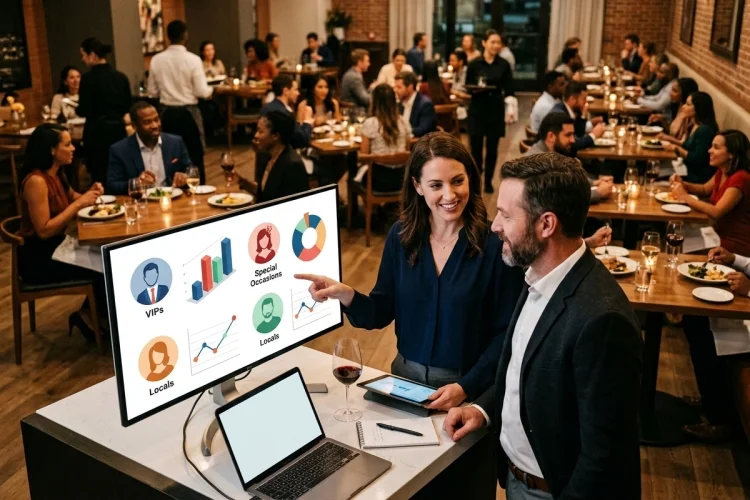
Restaurants used to know their best guests because managers recognized them at the door. That still matters, but it becomes difficult when a hospitality group serves thousands of customers across multiple venues and ordering channels.
Behavioral Dining Data gives operators another way to understand who their guests really are by looking at what they actually do.
Visit frequency, average spend, reservation timing, menu choices, party size, and special occasions can reveal much more than basic demographics, allowing restaurants to create useful guest segments without making hospitality feel robotic.
Move Beyond Age and Demographic Segmentation
Traditional marketing often divides customers by age, income, location, or household type. Those attributes can be useful, but they do not necessarily predict restaurant behavior.
Two 35-year-old professionals living in the same neighborhood may use the same restaurant completely differently. One could visit every Friday for cocktails with friends, while the other books a table twice a year for anniversaries.
Behavioral segmentation focuses on those differences.
OpenTable recommends building guest profiles from reservation history, visit frequency, spend patterns, ordering preferences, dietary requirements, seating preferences, and special occasions.
These records become more valuable as additional visits create a richer picture of each guest.
For restaurant operators, the key shift is simple: segment guests based on how they interact with the business, not only who they appear to be.
That makes the resulting segments much more actionable.
Use Visit Frequency to Identify Relationship Stages
Frequency is one of the clearest behavioral signals.
A restaurant can divide guests into first-time visitors, new repeat customers, established regulars, highly frequent guests, and lapsed customers.
These groups need different treatment.
A first-time guest may benefit from an introduction to signature dishes. Someone visiting twice every month does not need the same generic welcome email after every meal.
Lapsed guests are particularly interesting.
OpenTable’s work with Garces Group found that analysis of visit patterns helped the company understand when frequent diners typically returned, making it easier to identify customers whose normal behavior had changed.
That idea can be applied broadly.
If a customer normally visits every 30 days but has not appeared for 90, the absence itself becomes behavioural information.
Restaurants can then send a relevant invitation rather than blasting identical promotions to the entire database.
Segment Guests by Spend and Contribution
Spending behavior adds another valuable dimension.
Restaurants often identify VIPs purely by average check, but a guest’s financial value is more complicated.
Imagine Guest A spends $300 twice per year.
Guest B spends $85 every month.
Annual revenue from Guest A is $600, while Guest B contributes $1,020 before considering referrals or additional party members.
Frequency and spending should therefore be analyzed together.
Restaurant CRM platforms such as SevenRooms allow operators to build segments using behavioral criteria and spend patterns, including groups such as high spenders or brand champions.
A useful internal model might combine:
Recency + Frequency + Monetary Value
This resembles the RFM approach used widely in customer analytics.
Recent, frequent, high-spend guests typically deserve strong retention attention. High-spend customers who have become inactive may deserve a different campaign.
The objective is not labeling people as “valuable” or “unvaluable.”
It is understanding where marketing and hospitality resources can create the biggest return.
Add Dining Occasion to the Guest Profile
A guest’s reason for visiting can be as important as what they spend.
Some customers use a restaurant for business lunches. Others come for dates, birthdays, family meals, or drinks before an event.
OpenTable notes that party size, dining occasion, seating preferences, and visit history can help restaurants personalize future experiences.
Suppose a guest has booked four anniversary dinners over several years.
That pattern provides very different context from a customer who visits frequently for weekday lunches.
The anniversary guest might appreciate a quieter table, advance wine recommendations, or a reminder when reservations for a popular period open.
The business guest may care more about predictable service timing and convenient seating.
This is where behavioral segmentation becomes genuine hospitality rather than merely marketing automation.
It helps teams anticipate the type of experience someone is likely seeking.
Use Menu Behavior to Create Preference Segments
Order history can reveal surprisingly useful patterns.
A restaurant might identify regular steak buyers, vegetarian diners, wine-focused guests, cocktail enthusiasts, dessert buyers, tasting-menu customers, or people who regularly choose premium upgrades.
SevenRooms, for example, supports rules-based tags around behavior and dining preferences, including examples such as “steak lover.”
These categories can improve both marketing and in-person service.
A wine-focused guest should probably receive information about a new wine dinner before a generic lunch promotion.
A regular vegetarian diner could be told about a new plant-based seasonal menu.
But restaurants should avoid over-personalization.
Nobody wants a server announcing every previous order like a surveillance report.
The information should help staff make better recomendations naturally.
Good personalization feels like someone remembered you. Bad personalization feels like someone opened a database in front of you.
Build Segments Around Channel Behavior
Modern restaurants often interact with the same customer through several channels.
Someone may book dinner through a reservation platform, order delivery on weekdays, attend ticketed events, and occasionally visit another restaurant within the same hospitality group.
Those behaviors should ideally form one customer picture.
SevenRooms’ 2026 restaurant trends research found that 83% of surveyed operators believed connecting systems such as reservations, online ordering, delivery, and guest data would positively affect profitability.
The strategic opportunity is cross-channel segmentation.
A delivery-heavy customer who has never visited the dining room could receive an invitation to an in-person event.
A loyal dine-in customer who recently began ordering takeaway might respond to a convenient weekday offer.
Connecting these signals also prevents fragmented communication where one guest receives unrelated messages from several systems.
The challenge is data consistancy.
Duplicate profiles, missing identifiers, and disconnected platforms can quickly weaken segmentation accuracy.
Measure Whether Segmentation Changes Behavior
Creating clever segments is pointless unless they improve outcomes.
Restaurants should track changes in repeat visit rate, visit frequency, average spend, campaign conversion, retention, and time between visits.
OpenTable specifically recommends measures such as repeat visits, spending per guest, retention, review sentiment, and the interval between visits when evaluating personalization programs.
Suppose a “lapsed regular” campaign targets 500 guests.
If 75 return within 30 days, management has a clear behavioral outcome to evaluate.
The next question is whether those guests continue returning afterward.
Restaurants should also compare targeted campaigns with broader promotions.
If segmented communication consistently generates better booking rates without heavier discounting, the data strategy is producing genuine commercial value.
The best guest segmentation does not simply create more sophisticated dashboards.
It changes customer behaviour in measurable ways.
Behavioral Dining Data helps restaurants understand guests through visits, spending, occasions, menu preferences, and channel habits rather than relying on demographics alone.
Start with a few practical segments such as first-timers, regulars, high-frequency guests, and lapsed customers, then measure how each group responds.
Better segmentation should ultimately make marketing more relevant and hospitality feel more personal-not more complicated.