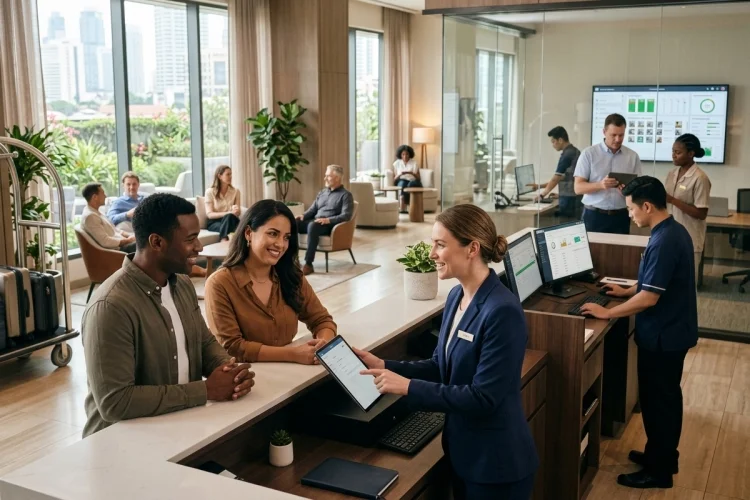
Hotels are complicated businesses. A single guest stay can involve reservations, housekeeping, front office, maintenance, food and beverage, payments, loyalty systems, and multiple technology platforms.
When those moving parts become difficult to coordinate, employees spend more time managing processes than serving guests.
Understanding How Hotels Reduce Operating Complexity is therefore becoming an important management skill. The goal is not to remove every service or reduce staffing blindly.
It is to simplify the work behind the experience so employees can respond faster, make fewer mistakes, and spend more time on interactions guests actually value.
Start by Finding Complexity Guests Never See
Operational complexity often develops slowly.
A hotel introduces a new report, adds another approval step, adopts a separate software platform, or creates a special process for one recurring problem.
Each change seems reasonable on its own, but years later employees may be switching between systems and following procedures nobody has reviewed recently.
Managers should start by mapping common workflows.
For example, follow a room from checkout through cleaning, inspection, maintenance clearance, and release back into inventory. If that process requires multiple phone calls, spreadsheets, paper forms, and repeated data entry, there is probably unnecessary complexity.
The best simplification projects target invisible friction first.
Removing a repetitive internal approval or automatically updating room status does not reduce hospitality. Guests probably never knew the old process existed.
Standardize Routine Work Before Automating It
Automation works best when the underlying process already makes sense.
Automating a confusing workflow simply allows the hotel to complete a confusing workflow faster.
Hotels should first decide the simplest correct way to perform repetitive activities such as room inspections, guest requests, maintenance reporting, cash reconciliation, or shift handovers.
Standardization also makes training easier. New employees do not need to learn five slightly different ways to complete the same task depending on which supervisor is working.
Oracle’s 2026 updates to OPERA Cloud, for example, emphasize embedding AI directly into familiar workflows so associates can receive operational guidance, automate routine tasks, and apply more consistent practices without adding separate systems.
The principle matters more than any particular technology: simplify first, then automate the repetative parts.
Protect the Human Moments That Guests Value
Hotels should not assume that every task becomes better when it becomes digital.
Guests may happily use mobile tools to request towels, update arrival times, pay a bill, or check opening hours. The same guest might still appreciate a warm welcome, help during a problem, or a thoughtful conversation about the destination.
Mews’ 2026 survey of more than 500 properties found widespread AI adoption across hotel tasks, but 59% of surveyed hoteliers still believed the welcome and check-in experience should remain human-led.
That suggests a practical rule.
Automate low-emotion transactions while protecting high-value interactions.
An employee should not spend five minutes copying reservation details between screens if that time could instead be used to recognize a returning guest or solve a problem.
This is how simplification improves service instead of making it feel colder.
Design Staffing Around Demand, Not Old Habits
Hotel staffing models often inherit patterns from previous years.
The same number of people may be scheduled at certain times simply because that has always been the schedule. But guest behavior changes by occupancy, arrival patterns, group activity, F&B demand, season, and day of week.
Better forecasting can align staffing with actual workload.
Housekeeping schedules can respond to departures and stayovers. Front-office coverage can follow arrival peaks. Restaurants can adjust staffing around reservations and expected covers.
The need for better workforce productivity remains significant. An AHLA survey published in February 2025 found that 65% of participating hotels still reported staffing shortages.
Simplification therefore should not mean forcing fewer employees to handle the same complicated processes.
It should reduce low-value work so available employees can handle demand more efficently.
Cross-Train Without Making Everyone Do Everything
Cross-training can also create flexibility.
A front-office employee may learn basic concierge functions, while selected restaurant employees can support event service during demand spikes.
However, excessive cross-training can create confusion.
Employees still need clear ownership and enough specialization to perform important tasks well. Flexibility should reduce bottlenecks, not create a workplace where nobody knows who is responsible.
Reduce Handoffs Between Departments
Every handoff creates an opportunity for information to disappear.
A guest tells the front desk about an air-conditioning problem. The front desk messages maintenance. Maintenance repairs the unit but forgets to update housekeeping. Later, another employee asks the guest whether the problem was resolved.
The repair itself may have been simple. Communication created the complexity.
Integrated task-management systems can reduce this problem by creating one visible request with ownership, status, priority, and completion information.
Hospitality technology discussions for 2026 increasingly emphasize integrated systems and smoother information flow rather than simply adding more standalone tools.
Shiji’s industry outlook argues that simplification can improve both employee performance and guest trust when operations are designed around the guest journey.
Reducing handoffs can therefore improve both speed and service consistency.
Simplify SOPs Around Outcomes
Standard operating procedures are necessary, but longer does not always mean better.
A fifty-step checklist can theoretically control every situation while making employees less likely to follow it correctly.
The strongest SOPs make the desired outcome obvious.
For a guest complaint, the objective might be: acknowledge the issue quickly, take ownership, resolve it within defined authority limits, record the outcome, and escalate only when necessary.
Managers can support this with decision boundaries rather than requiring approval for every small action.
Giving employees reasonable authority can remove unnecessary managerial bottlenecks while improving response time.
The aim is standarization without turning hospitality into robotic script-following.
Measure Whether Simplification Actually Improves Service
Cost savings alone are not enough to prove that a simplification project worked.
Hotels should monitor guest satisfaction, complaint frequency, response times, housekeeping productivity, employee turnover, service recovery, labor hours, and operational errors.
If a new self-service process reduces front-desk labor but generates more guest complaints, the hotel may have shifted complexity from employees to customers.
That is usually a poor trade.
PPHE Hotel Group’s move toward a standardized cloud PMS across 18 properties was positioned around both operational performance and giving associates mobile access to information such as housekeeping priorities and loyalty data.
The most valuable simplification makes the organization easier to operate while making the guest journey feel smoother.
That balance should remain the main measurment of success.
Learning How Hotels Reduce Operating Complexity is not about stripping hospitality down to the cheapest possible model.
It is about removing repetitive work, unnecessary handoffs, outdated procedures, and fragmented processes while protecting meaningful human service.
Start by mapping one common guest journey, identify the internal friction guests never value, and simplify that workflow before investing in additional people or technology.